The forex market in 2026 is being driven by a various major factors. Such as central bank decisions, inflation numbers, jobs data, and global political developments. And because of them, prices can shift in seconds.
For traders, the difference between a planned response and a panicked reaction often comes down to preparation. In this blog, we will cover the key high-impact events to watch in 2026 and the practical steps, such as stop-loss order and 3 5 7 rule in trading.
What Are High-Impact Market Events in 2026?
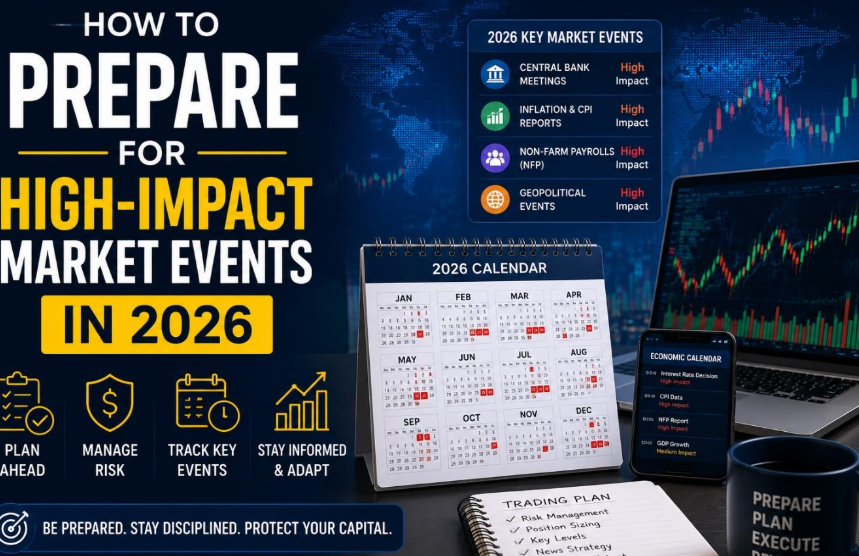
High-impact market events can cause significant and rapid price movements across financial markets. In 2026, with central banks managing uneven inflation, political uncertainty across major economies is expected. Here are the key events that every trader should be watching:
- Central bank rate decisions: The Federal Reserve, European Central Bank, Bank of England, and Bank of Japan all hold scheduled policy meetings throughout the year.
- Non-Farm Payrolls: Released on the first Friday of every month, this report measures employment changes in the US economy. Any significant deviation from the consensus forecast can trigger sharp and sudden moves across major currency pairs.
- Inflation data: Figures such as CPI and PCE show how much prices are rising in major economies. Central banks watch these closely because they use them to decide whether to raise or cut interest rates. And when interest rate expectations shift, currencies move with them.
- US political developments: US politics is also playing a big role this year. The midterm elections are shifting how the government thinks about spending, regulation, and fiscal policy. Additionally, the ongoing debates over the debt ceiling and the national budget are keeping traders on edge, especially regarding the Dollar.
- Geopolitical risks: Trade policy changes, sanctions, and supply chain disruptions remain very much alive in 2026. The important part is that, unlike an interest rate decision or a jobs report, these things do not have a scheduled date and time. They just happen. Which is why keeping up with what is going on in the world is not optional for traders. It is part of the job.
What Are Forex Trading Hours and Why Do They Matter?
One of the most overlooked aspects of preparing for high-impact events is understanding what are forex trading hours and how they affect market behaviour during these moments.
The forex market runs 24 hours a day, five days a week. It moves through four sessions: Sydney, Tokyo, London, and New York. Each session has its own pace, but the one that really matters is when London and New York are both open together. That window runs from around 12:00 to 16:00 GMT, and it is where most of the big economic data drops.
When London and New York overlap, spreads widen, and prices can move quickly. That is why knowing when a high-impact event is scheduled is important. You can plan how much you want to risk and size your positions accordingly to make a clear decision about whether to trade through the release.
How to Prepare for High-Impact Events?
Preparation does not have to be complicated. Here is a structured approach that any trader can follow before a high-impact event:
Step 1: Use the Economic Calendar
The economic calendar is your most important tool. Review it before every session to see which data releases are scheduled. Markets that are likely to affect, and what the current consensus expects. Making this a regular part of your pre-session routine means you may never be caught off guard by a scheduled release.
Step 2: Review Your Open Positions
Before a high-impact event, you can go through your every open position and ask yourself whether your current stop loss and position size account for the possibility of a sharp and sudden move. If not, adjust before the event arrives, not during it.
Step 3: Apply the 3 5 7 Rule in Trading
The 3 5 7 rule in trading may help you manage your risk and stay in control when the market gets volatile:
- 3%: Limit your risk to 3% of your total capital on any single trade. This way, even if the trade does not go your way, the loss stays small and your overall capital stays intact.
- 5%: Keep your total open risk across all trades within 5% of your capital at any given time. This prevents you from overexposing yourself when multiple trades are running at once.
- 7%: Always aim for at least 7% profit on your winning trades. This makes sure your gains are consistently meaningful, and your account continues to grow over time.
Step 4: Set Your Stop Loss Order Correctly
Understanding how a stop-loss order works in trading is important during high-impact events. A stop loss is an instruction that automatically closes your position if the price moves against you by a set amount. It removes the need to make decisions under pressure. That is why, before any major event, make sure your stop-loss is set at a level that accounts for wider-than-normal price swings.
Step 5: Reduce Your Position Size
During high-impact events, you can consider reducing your position sizes. This may help if the market moves against you. The impact on your capital stays manageable.
Step 6: Choose When to Enter the Market
You can choose when to enter the market. If your strategies are not built for news-driven volatility, you can close open positions before the release and wait for conditions to normalise.
How to Read the Market After a High-Impact Event
Once a high-impact event is over, the market does not always move in one clear direction straight away. The first move you see right after a release is often driven by automated systems and can reverse just as quickly as it started.
Therefore, waiting a while after the announcement before acting may allow the initial spike to settle. From there, focus on whether the price is holding above or below key levels and whether the move is being stable or fading.
Conclusion
High-impact market events are a permanent part of trading. They cannot be avoided. But with the right preparation, they do not have to be feared either.
In 2026, knowing forex trading hours and when major events fall within them, using a stop-loss order correctly, and applying the 3 5 7 rule to manage your risk, gives traders a structured and confident approach to volatile conditions.
About the Author