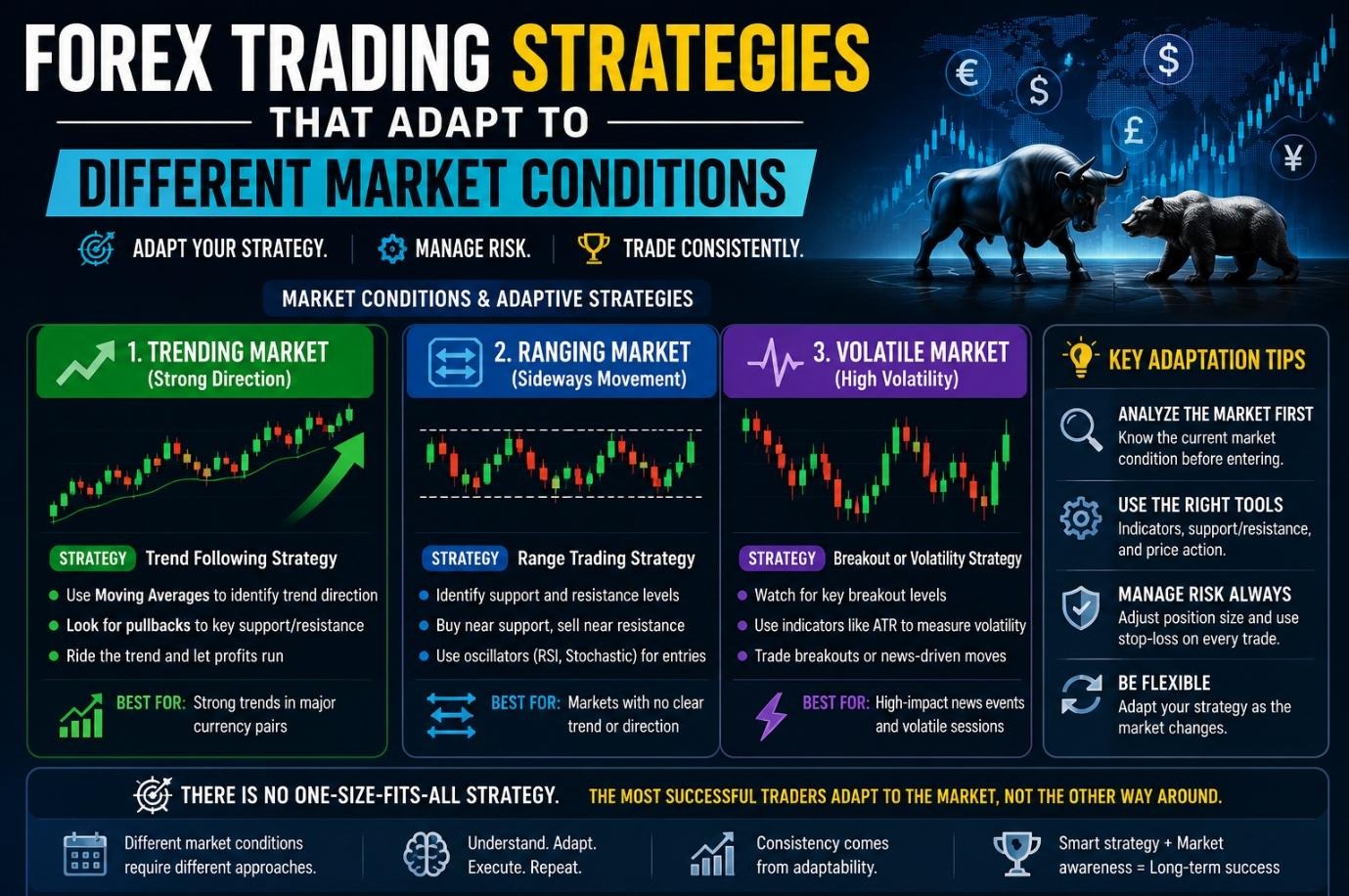
The forex market never stays the same. Some days prices move strongly in one direction, while other days they move sideways or become highly unpredictable. This is why successful traders do not rely on a single approach. Instead, they adjust their Forex trading strategies in response to market movements.
Understanding different market conditions can help you make smarter trading decisions, reduce unnecessary risks & improve consistency over time. Whether you are a novice or a seasoned trader, learning to adjust your trading strategies can help you trade with more confidence.
Why Market Conditions Matter for Forex Trading Strategies?
No trading strategy performs well in every situation. A strategy that works during a strong trend may struggle when the market is moving sideways.
Before entering any trade, experienced traders first identify the current market condition. This allows them to choose the right approach rather than forcing trades with a lower chance of success.
Many traders use the MT5 trading platform because it offers advanced charting tools, indicators, and multiple timeframes, making it easier to analyse changing market conditions before placing trades.
The three most common market conditions include:
- Trending markets
- Range-bound or sideways markets
- Highly volatile markets
Understanding each one can help you choose more suitable Forex trading strategies.
How to Identify Different Market Conditions?
Before selecting a strategy, it is important to know what the market is telling you.
Here are a few simple signs to look for:
Trending Market
A trending market moves consistently upward or downward. In an uptrend, prices form higher highs and higher lows, while a downtrend is characterised by lower highs and lower lows. Moving averages generally point in the direction of the trend, and strong momentum often results in fewer price reversals. Trend-following strategies generally perform better in these conditions.
Range-Bound Market
In a range-bound or sideways market, the price may bounce between support and resistance levels without establishing a clear direction. Momentum is usually lower, and prices move within a defined range rather than forming a sustained trend. These conditions are generally more suitable for range trading strategies.
Volatile Market
Volatility often increases during key economic news releases, central bank statements, geopolitical events and other unexpected market developments. During these periods, traders usually place greater emphasis on risk management than on increasing trade volume.
Best Forex Trading Strategies for Trending Markets
Trending markets offer opportunities to follow the overall direction of price movement rather than trade against it.
Some popular trend-following methods include:
Moving Average Strategy
Moving averages are used to smooth out price fluctuations and determine the overall direction of the market. Many traders look for opportunities to buy when the price is above the moving average and look for opportunities to sell when the price is below it.
Breakout Trading
Breakouts occur when the price breaks through key support or resistance levels. They could signal the beginning of a new trend, a more powerful buying or selling pressure and more market participation. However, traders often wait for confirmation before entering, to cut down on false breakouts.
Trendline Trading
Important highs or lows are connected by trendlines that indicate the market’s direction. They can assist traders in finding potential entry points, identifying areas in which trends may continue and placing stop-loss orders more efficiently.
Forex Trading Strategies for Sideways Markets
Not all markets have trends. Prices sometimes trade in a tight range for days. Traders tend to modify rather than chase breakouts.
Support and Resistance Trading
Many traders look for buying opportunities near support levels and selling opportunities near resistance levels. They also like to exit their positions before the price reaches the other side of the range. This approach generally works best when the market is stable.
Oscillator Indicators
RSI or Stochastic Oscillator can be used as indicators to determine if the market is overbought or oversold. Further confirmation from these indicators might be available before initiating range trades.
However, no indicator should be used alone without considering overall market conditions.
Trading During High Volatility
During highly volatile market conditions, traders often reduce their position size, use wider but carefully planned stop-loss levels and avoid emotional decision-making. Many also prefer to wait until the initial market reaction to major news events has settled before entering a trade.
How to Adapt Your Forex Trading Strategy?
There is no single strategy that works all the time. Before selecting an approach, ask yourself:
- Is the market trending or moving sideways?
- Has volatility increased recently?
- Are there any important economic announcements coming?
- Does the strategy match your trading style?
- Have you tested the strategy before using real money?
Answering these questions can help you apply forex trading strategies more effectively instead of relying on guesswork.
Conclusion
No market condition lasts forever, so one of the most valuable skills a trader can develop is to be adaptable. The market can be trending, ranging or very volatile. When you learn to identify this, you can choose Forex trading strategies that are more in tune with current market conditions rather than relying on a single method. Add to this some market analysis, good risk management and regular practice, and you can (over time) improve your decision-making. As you gain more experience, you can adapt your Forex trading strategies to changing market conditions, which can help you trade with more confidence and develop greater consistency in the ever-changing Forex market.
About the Author