Walk onto any active job site, and you’ll see the crane first. It’s hard to miss — towering steel, cables under tension, the low hum of hydraulics doing serious work. But spend five minutes talking to an experienced rigger, and they’ll tell you the same thing every time: the crane is only as good as what’s hanging beneath it.
That’s the world of below-the-hook lifting hub devices — and it’s a world that doesn’t get nearly enough attention.
This hub is built to change that. Whether you’re a site supervisor trying to spec the right gear, a safety manager tightening your lifting protocols, or a newcomer trying to make sense of it all, this is your starting point.
What “Below the Hook” Actually Means
The phrase sounds technical, but the concept is straightforward. Below-the-hook lifting devices refer to every piece of equipment that sits between a crane’s hook and the load being lifted. Slings, beams, clamps, magnets, vacuum lifters — if it connects your crane to your load, it falls into this category.
The American Society of Mechanical Engineers (ASME) governs this space through its B30.20 standard. That document covers everything from design and manufacturing to inspection and safe operation. If you’re working in a regulated environment — and most of us are — B30.20 isn’t optional reading. It’s the rulebook.
What makes this category so important is simple: a failure anywhere in this chain doesn’t just damage equipment. It puts people’s lives at risk. Getting it right every single time isn’t a goal. It’s the baseline.
The Main Types of Below-the-Hook Lifting Devices
One of the first things people discover when they dig into this subject is just how many options exist. Here’s a breakdown of the most commonly used devices and where they shine.
Lifting Beams and Spreader Beams
These are the go-to tools for long, heavy loads. A lifting beam uses a single overhead attachment point and distributes the load across two or more lower pick points. A spreader beam, by contrast, uses two upper attachment points spread apart to eliminate the inward compression that angled slings create.
They’re used constantly in structural steel, precast concrete, and industrial equipment installation. When a load is too long, too flexible, or too sensitive to handle with standard slings alone, a beam is usually the answer.
Plate Clamps and Structural Clamps
Clamps attach directly to the load — no slings needed on the load side. Vertical plate clamps grip steel plates along their edge for upright lifts. Horizontal plate clamps hold flat stock for a flat carry. Beam clamps fit around structural sections like wide-flange beams and channels.
These are staples in steel fabrication yards and structural construction. Fast to attach, reliable when maintained, and purpose-built for repetitive picks.
Vacuum Lifting Devices
For smooth, non-porous loads — glass panels, polished metal sheets, concrete slabs — vacuum lifters are the clean solution. They use suction cups driven by pneumatic or electric power to grip surfaces without any mechanical contact that could scratch or deform the material.
You’ll find them everywhere, from glass manufacturing to precast concrete handling to aerospace component assembly. They’re fast, gentle, and very effective when matched to the right surface.
Magnetic Lifters
Permanent magnet and electromagnetic lifters are common in steel processing, fabrication shops, and scrap handling. They attach instantly to ferrous materials with no rigging on the load side — just position, energize, and lift.
The distinction between permanent and electromagnetic models matters for safety planning. A permanent magnet holds without power; an electromagnet releases when power is cut. Both have their place, but each requires a clear understanding of the failure modes involved.
Coil Hooks, Drum Lifters, and Specialty Devices
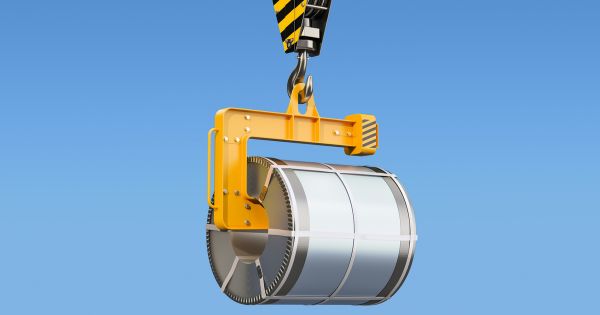
Beyond the standard lineup, there’s a whole range of specialty below-the-hook lifting devices designed for specific load types. Coil hooks handle steel coils. Drum lifters grip cylindrical containers. Custom lifting frames are engineered for oversized or irregular equipment.
The underlying principle is always the same: the device has to match the load’s shape, weight distribution, and surface characteristics — not the other way around.
Why Rigging Equipment for Cranes Gets Overlooked
Here’s an honest observation: rigging equipment for cranes is chronically under-prioritized on many job sites. The crane gets the budget, the lift plan, and the attention. The below-the-hook hardware gets ordered at the last minute, borrowed from another project, or selected based on “what we used last time.”
That approach creates real risk. Using the wrong device for a load doesn’t always cause an immediate failure — sometimes it just puts invisible stress on equipment that’s slowly being degraded. By the time something goes wrong, nobody connects it back to the casual gear selection made three projects ago.
The correct approach is to evaluate every lift on its own terms: load weight, center of gravity, surface condition, lift geometry, environmental factors, and regulatory requirements. Crane lifting equipment — including everything below the hook — deserves the same deliberate planning as the crane itself.
Construction Lifting Devices: Specific Challenges on Site
Construction lifting devices operate in some of the most demanding conditions in any industry. Outdoor environments bring wind, rain, mud, and temperature swings that all affect how equipment behaves. Loads vary constantly — one pick is a precast panel, the next is a bundle of rebar, the next is a mechanical unit being set on a roof.
Add the time pressure of a construction schedule, and you have a high-risk environment where the temptation to cut corners is real, and the consequences of doing so are severe.
The best construction teams treat their below-the-hook inventory the same way they treat their tools — with a clear system for selection, a discipline around inspection, and zero tolerance for using gear that hasn’t been checked.
Inspection: The Step Nobody Wants to Skip
Every piece of crane lifting equipment has two inspection requirements under ASME B30.20: frequent inspection before each use, and periodic inspection at scheduled intervals based on usage and conditions.
Frequent inspection means physically checking for cracks, deformation, corrosion, worn pins, damaged locking mechanisms, and legible capacity markings before every lift. It takes a few minutes. It’s non-negotiable.
Periodic inspection is more thorough — it may include dimensional checks, load testing, and detailed documentation. The interval depends on how hard the equipment works and in what environment.
Any device that doesn’t pass gets pulled from service immediately. No delays, no exceptions.
The Bottom Line
The crane is the headline. But below the hook lifting devices are where the technical precision actually lives — where load meets machine, where physics meets responsibility, where the right call protects lives, and the wrong one doesn’t.
The Below-the-Hook Hub exists to make that body of knowledge accessible, practical, and genuinely useful for the people doing this work every day. Whether you’re selecting rigging equipment for cranes, planning lifts with specialty construction lifting devices, or building out a compliant equipment inventory, the goal is the same: every lift, done right, every time.
Come back to this hub as your go-to reference. There’s always more to learn — and in this field, that knowledge is never wasted.
About the Author